Sunday, March 1, 2009

The Joy Crisis

There are large, powerful schools of American educational theory that state bluntly: Our schools are in a state of CRISIS. This bold pronouncement is usually backed up by mountains of data amounting to spelling the word 'CRISIS' with flashing red lights while the theme from Schindler's List plays on repeat. And it's not without merit. One in three students will never graduate from high school and rural and urban schools across the country have become 8am-3pm dumping grounds from poor students who aren't developing the schools to meet basic literacy and math standards.

Yasmine, Mongilal & Seema Get Their Joy On

This depressing shovel is one way to dig into the issue of education. At The Merasi School, we have tried another approach. The Merasi have enough pre-determined obstacles in their path - living on .25 cents a day, being born without birth certificates, assigned the social worth of pollution- that we'd get plenty of nowhere by focusing on what education they don't have.

So we turned the tables and decided to focus on what they can do, have and be with education. By shifting from a framework of deficits to a framework of assets, the possibilities explode infront of the students like cherry blossoms in the DC spring. In its best form, education nurtures the raw potential that each student brings into the classroom and ripens it into its fullest expression. It is a fundamentally hopeful undertaking. It's something to be -- to use a word rarely associated with America's public schools -- joyful about it.

Most absolutely, the American educational institution is in need of serious attention. But it will not sustainably emerge from painting headlines with terrifying statistics about underperforming schools. Rather, I think that constructive change will be the product of families, educators and students developing bone-deep excitement about what can and must exist inside the classroom.

Friday, February 20, 2009

Nipping Brain Drain in the Bud

The Merasi School is remarkable. But, in truth, there's nothing remarkable about that. Every person, work of architecture, afterschool program and fingerpainting on the fridge is worth making a remark about. Remarkability has a few different shades to it, though, and that's where Sarwar and I are particularly attentive.

Part of what distinguishes The Merasi School is that it offers kids an opportunity to explore worlds of knowledge, databases of information and patterns of thought that were previously locked far away from their inquiring minds. With this new influx of ideas and stimulus, the world becomes a bit more colorful and expansive and, ideally accessible. Which is part of what we're trying to do.

The other side of that equation, though, is that once an individual begins to see the scope of the world beyond their own and develops the educational capacities to influence and shape that world, the classic brain drain question emerges: Why should they stay home? What is to keep them from going off to bigger, brighter more open cities where caste doesn't dictate social interaction and they can be valued for the quality of their heart and mind?

Here's what makes The Merasi School remarkable: The music. The Merasi have a precious, gorgeous artistic legacy woven into the narrative fabric of Jaisalmer and Rajasthan. The songs are the oral history of a culture that doesn't exist anywhere else in the world. The rhythms and beats the students learn in music class with teacher Karim Khan are situated in a particular landscape. With education, our little ones are honing the fine, constructive skills to shift the heart and soul of that landscape.

It's not a flawless plan. Perhaps some students will get a taste of broader worlds and never look back. Yet many are already showing signs of sinking their heels further into their communities. As they do that, they each contribute to the expansion of the hope and possibility in their own backyard.

Tuesday, January 20, 2009

Fitzgerald Visits The Merasi School

Over coffee with a friend the other night, I was reminded of an excellent old F. Scott Fitzgerald quote that lay in my battered moleskin journal. "The test of first rate intelligence," Fitzgerald bellowed from the pages of a 1936 Esquire, "is to hold two opposing views in one's mind at the same time and still function. One should be able to see that things are hopeless, yet be determined to make them otherwise."


Rasul Khan looks to what's beyond

It's a mighty mouthful that is sticky and awkward to chew, but paves the blueprints and cornerstones of our work out in Rajasthan. Caste barrels down on our little ones, bringing them into this world without a birth certificate, forcing them to live on less than 25 cents a day and robbing them of their right to participate in a society begging for justice-fueled change. But caste is far from everything. It is one reality in a world of many.

Caste is neighbored by an unbelievably musical legacy that can be found in no other pocket of the globe. It is an artistic heritage that enables students to stare defiantly and compassionately in the face of all the crushing forces telling them they are worthless and say, as Rasul Khan did, "I'll be an engineer" or Fridah Khan, "I will be a very, very good teacher."

Rasul and Fridah know the world is not a warm place for them. Yet they also know that they have the capacity to rewire this reality towards a habitat of justice and hope. The music and the education go hand-in-hand, as necessary as having both a heart and a mind. And so we move forward, supported by the backbone of Folk Arts Rajasthan, our parent non-profit, with these two realities in our hands, functioning with both the weight of reality and hope.

Sunday, January 4, 2009

If you see a turtle on a fencepost...

FIRST and foremost: HAPPY 2009 to you and yours! May it be a year brimming with merriment and peace.

SECOND and just as foremost: Bill Clinton used to say that if you see a turtle sitting on a fencepost, it was there for a purpose. It did not drop from the sky or get swept up in a mighty gust of wind that placed it square on top of the fence. The turtle was there because something or someone intentionally put it there. Intentionality is a great word and one that I've become quite fond of through this Merasi School work.

Sarwar and I agree that The Merasi School is an intentional educational undertaking: each slice of programming is fueled with purpose and drive. And yet, there's something missing to that little equation, that undescribed x-factor that happens when your intended plans aren't unfolding as they should and expectations are dropping like flies on the roadside.


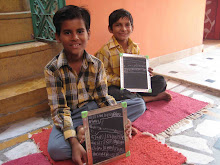
With this picture, for example, my plan was to get the kids to spell out 'THE MERASI SCHOOL' on the slates. But, as we primed and preened for the shot, what emerged was the discovery that Mr. Ali, the strapping lad in the center and a new student as of that day, didn't know how to spell 'MERASI.' And so a lesson instruced by his fellow slate-holders ensued.

But that's just one, bite-sized example of immediate reality or needs trumping intentions. Poverty, as we've talked about before, is a fickle master who will take your intentions and crush them like a two-ton stone crushes a china vase. Our intentions are well-founded and I used to think that reality gets in the way of my placing the turtle on the fence.

But what I'm slowing starting to believe is that I need to create more room for reality in the crafting of our intentions. Reality and all the baggage, packages and beautiful complications that come with, are powerful indicators of why the path from turtle in pond to turtle on fence is much more windy, precarious and beautiful than we originally bargained for.

Tuesday, December 30, 2008

The Percentages

Greetings from snowy Maine! Once again, I have timed it perfectly. I arrived home from The Merasi School at the IDEAL MOMENT for snow shoveling, sidewalk sanding and ice removal. Some of us, my dear friends, just have it made. But, in between hauling sky-high mounds of snow from this side of the driveway to the other, I'd like to offer a few post-trip reflections. And a particular favorite is one about percentages.

Co-founder Sarwar Khan and I often found ourselves chatting about what the necessary ingredients are for educational success in the Merasi community, what pieces of ideology and slices of belief need to go into our little cooker for a triumphant Merasi to emerge. While we certainly never landed on a definitive, Julia Child-eat-your-heart-out recipe, in part because our definition of success is fluid and ever-evolving, we inched just a bit closer to a formula I think is worth sharing.

Education, we came to agree, is 50% intellect, which our school is just brimming with, and 50% believing, which is a bit harder to unearth in many students. Most kids walk in the front door with more than enough ability to succeed in our classrooms, or really any classroom, for that matter. But it's the belief, the confidence that they can and will own this knowledge that's a bit tougher to find or cultivate.


Some of our students, like the Good (aspiring) Doctor Suriya Khan come into our lessons and classes with an innate confidence and we work to constructively build and grow that. Others, though, have a little less internal umph and one of our greatest academic challenges is to nourish and feed a sense of 'I can-itness' within our 41(!) students.

It's a tricky road to walk and one that we're just getting our footing on, but we're confident that our students' confidence and self-belief is within spitting distance. Now comes figuring out where, what and how great the distance is.

From all of us here at The Merasi School, have a merry, joyful and, of course, highly educational New Year!

Monday, December 15, 2008

A little something we like to say

There's a little something we like to say here at The Merasi School that goes to the tune of: Let unconquerable gladness dwell. It's a sentiment we stole right from FDR's Oval Office and transplanted into our desert classroom and the words echo through our hallways.

Now, if we are going to be total realists, my dear readers, what I just wrote was a boldfaced lie. For youngsters just wrapping their mouthes around 'red' and 'ball,' a multi-syllabic whopper like 'unconquerable' and the awkward consonants in 'dwell' are mish-mashed and pancaked smashed into all kinds of colorful variants. However, while the verbal packaging might be different, the contents are identical. Indefatigable joy resides at The Merasi School.

And there's nothing soft or gentle about this joy. It's a fierce current of energy that grows stronger and brighter with each student who joins our ranks and pours their young hearts and souls into developing core educational competencies to engage in a rapidly interdependent world. It's a joy that defies reason, because all reason says that these little ones --who are forced to drink from different water spouts than other castes and sit with the shoes in public places-- should lead joyless lives.

But if The Merasi School is anything, it is a small cluster of classrooms where possibility trumps reason and unconquerable gladness overpowers crippling reality. So as we charge through abc's and 123's with mighty merriment, we inch ever closer to the day when 'unconquerable gladness,' which is felt in so fiercely in the fibers of our little ones, can be just as fiercely verbalized.

Thursday, December 11, 2008

Observing with the Ears

I have a wonderful friend who loves to go to the symphony. We went together once and he sat like Rodin's The Thinker the whole time, while I shifted from one side of the seat to the other, reached for popcorn that wasn't there and clapped at all the wrong times. A few days later over breakfast, I asked him what he was doing and he said, "It's the best way for me to really see the music."

Fast-forward three years and three million cultural miles and I'm at The Merasi School with Sarwar Khan. We were talking about the Merasi musical legacy, a precious stand of songs that could easily wash away with the desert sands as modernization charges across India. "The thing is," Sarwar said, sweeping his hands towards the classrooms. "The kids observe with their ears. If there's no music being played, there's nothing to observe."

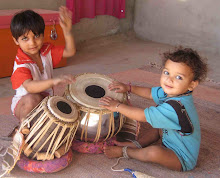
And it makes sense. The Merasi say they cry, sleep and laugh in rhythm, little boys and girls are as comfortable with a drum as they are with holding their mothers' hands. Music seeps through wind and time with a powerful cultural osmosis that is vanishing rapidly. "So it seems like part of what we're tying to do here," I said, "is put a somewhat more formal shape and a form into a style of learning that had a much more informal means of transmission." "Sure," Sarwar said. "We're giving them classes." Which was, of course, an infinitely more concise way of saying what I'd been swinging at.

So at The Merasi School, we learn with all our senses in all different ways. We see the landscapes in sounds and hear the loudness in landscapes. Our learning styles are as different as our handwriting, as distinct as our thumbprint. Each child that walks in the door brings a toolbox of potential learning matches that can be ignited if we commit to not just learning the word or the book, but learning the world.