My father and I talk baseball a fair amount. While my father churns out the facts, I fancy myself more of a color commentator, likening the field to a finely manicured chia pet or drawing powerful comparisons between the shape of a hot dog and the curve of the pitcher's wily smile. One foggy afternoon, my father and I were at the ballpark, watching intently as the clouds closed in at the top of the third. "DON'T let it rain," I declared. "In my book, this is not a day for rain." To which my father, rascal that he is, decided that today, he'd be adding the color to the commentary. "Satchel Paige used to say that if you pray when it rains, you'd better pray when it's sunny, too."
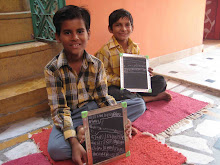
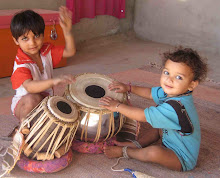
Thanks to Mr Paige and a few afternoon clouds, I've taken to a bit of all-weather prayer, which has opened up into all-weather gratitude. But, in truth, I've got it easy. Because in my line of work, it's folks like you, our Team Merasi members (you big-hearted studmuffins, you) who extend a hand when forecasts are gorgeous and lousy, who make me a continually appreciative soul. We hatch plans and cook up ideas, but each one of you provides the support needed to translate thoughts in our minds to actions in our hands. I, Caitie Whelan, am headed back to our desert classroom in just a few days and look forward to reporting from The Merasi School where a little rain and wind never gets in the way of a great day at school.
From our doorstep to yours, we send our heartiest and merriest thanks!
Sunday, November 23, 2008

Friday, November 21, 2008
The Question that Keeps Coming
If we were to create a visual representation of The Merasi School, it would look something like so many Jackson Pollock's piece collaged together. Not because we're in a perpetual state of chaos, but because the most constant pattern in our work is unpredictability and the Great Unknown. While many painters gave us predictable scenes of cheery fruit and stoic portraits, Pollock produced works of unsettling beauty. And that's the most common pattern at The Merasi School. While poverty creates time structures with no rhyme or reason, our fierce little students' determination and grit make beautiful perseverance the foundation of our work.
So, the question that pops up all the time, over dinner and at coffee, among new friends and old ones, is almost always: "Why do you bother? What's the point? The situation is so bleak, the need is so high. How effective (and this part is always said very gently) do you hope one school to really be?"
And they're right...in some ways. Oftentimes, it seems as though the size of our solutions is dwarfed by the size of the problems. But you can't just walk away from that. There's an excellent Fitzgerald quote that goes something to the tune of "One should be able to see that things are hopeless, yet be determined to make them otherwise." We can hold two opposing realities in our hands: the bitter caste system and the tremendous hope of education and while the world may suggest that one is more important than another, it is our prerogative as thinking, acting beings to constantly reshape the value of realities towards the realization of justice.
Now have we fully realized that at The Merasi School? Absolutely not. Far from it. We are a perpetual work in progress. But we know that at least part of our effectiveness is embedded in the fact that we'll get up everyday with these two opposing realities in front of us and commit to making more space for the unsettling beauty that lies before us.
So, the question that pops up all the time, over dinner and at coffee, among new friends and old ones, is almost always: "Why do you bother? What's the point? The situation is so bleak, the need is so high. How effective (and this part is always said very gently) do you hope one school to really be?"
And they're right...in some ways. Oftentimes, it seems as though the size of our solutions is dwarfed by the size of the problems. But you can't just walk away from that. There's an excellent Fitzgerald quote that goes something to the tune of "One should be able to see that things are hopeless, yet be determined to make them otherwise." We can hold two opposing realities in our hands: the bitter caste system and the tremendous hope of education and while the world may suggest that one is more important than another, it is our prerogative as thinking, acting beings to constantly reshape the value of realities towards the realization of justice.
Now have we fully realized that at The Merasi School? Absolutely not. Far from it. We are a perpetual work in progress. But we know that at least part of our effectiveness is embedded in the fact that we'll get up everyday with these two opposing realities in front of us and commit to making more space for the unsettling beauty that lies before us.
Wednesday, November 12, 2008
Remixing the Hash
Birds of a feather is a dangerous little axiom. Like a bee to honey, I gravitate towards those trains of thought, newspapers, radio shows and organizations that support my own thinking. They are wonderful little reinforcers, serving to give me a big, hearty slap on the back and say, 'Way to go, Tiger! Once again, you've proven yourself to be a towering interpreter of our times." And it feels terrific to be so right so much of the time.
But the curtain came crashing down on that little Utopian play right around the time I turned seven and, after many retreats to the time-out corner, realized that not everyone enjoyed listening to my OUTSIDE VOICE as much as I did. Fast forwarding to this moment in time, no matter how tremendous my ideas might be, there will always be better ones and there will always be dissenters. And, it's pretty stunning, but those dissenters can often be the bridge needed to get you from where you are with a half-baked idea to an explosive launching pad.
History's painted with examples of it: In the Vatican, they called it the Devil's Advocate, an individual who was supposed to shake up the conversation by interjecting the devil's prospective. Eisenhower made up a cabinet of yes AND no men who shoved and tugged at his perspective. The UN has released several compelling arguments for the accelerated inclusion of women in political discourse, stating that a female, relational perspective is a powerful counterbalance to the male, tactical perspective. And what shakes out from inviting in the other opinions? Well, if you can really listen, I think an awful lot.
At The Merasi School, I call problem solving Hashing. But, oftentimes, my Hash muscle digs itself into a mono-focus rut where it spits out the same uniform approach to every issue that comes barreling down the pipeline. If you think about an approach like a tool box and all you've got is a hammer, every problem starts to look like a nail. It could be perfect for one problem, but have all the utility of hot fudge in the operating room for another. But, if you begin to fill it up with wrenches and drill bits and sandpaper, problems start to take on a different appearance.
So, I think the Hash needs to be remixed. Regularly. It insures that at any point in time, you have access to a veritable arsenal of approaches to address a given issue. Here are a few that get regular airtime at The Merasi School: a brilliant buddy of mine named Steve once said that play is the foremost metaphor for problem-solving. How would you play and tease your way through a problem of epic scale? Try digging a bit deeper into your analysis: the author Calvin Trillin once said that a hummingbird weighs as much as a quarter. Does that mean it weighs as much as two dimes and a nickel, too? Ask why: There is this great Clara Barton quote that goes something to the tune of 'I defy the tyranny of precedence.'
And there are heaps more, oddles of other tools to give your perspective the necessary jitters to open up a bit more. Our students learn in different ways, digest information and ideas through different processing mechanisms, it's only fitting that we approach the conflicts they face with as much respect for differentiation as possible.
But the curtain came crashing down on that little Utopian play right around the time I turned seven and, after many retreats to the time-out corner, realized that not everyone enjoyed listening to my OUTSIDE VOICE as much as I did. Fast forwarding to this moment in time, no matter how tremendous my ideas might be, there will always be better ones and there will always be dissenters. And, it's pretty stunning, but those dissenters can often be the bridge needed to get you from where you are with a half-baked idea to an explosive launching pad.
History's painted with examples of it: In the Vatican, they called it the Devil's Advocate, an individual who was supposed to shake up the conversation by interjecting the devil's prospective. Eisenhower made up a cabinet of yes AND no men who shoved and tugged at his perspective. The UN has released several compelling arguments for the accelerated inclusion of women in political discourse, stating that a female, relational perspective is a powerful counterbalance to the male, tactical perspective. And what shakes out from inviting in the other opinions? Well, if you can really listen, I think an awful lot.
At The Merasi School, I call problem solving Hashing. But, oftentimes, my Hash muscle digs itself into a mono-focus rut where it spits out the same uniform approach to every issue that comes barreling down the pipeline. If you think about an approach like a tool box and all you've got is a hammer, every problem starts to look like a nail. It could be perfect for one problem, but have all the utility of hot fudge in the operating room for another. But, if you begin to fill it up with wrenches and drill bits and sandpaper, problems start to take on a different appearance.
So, I think the Hash needs to be remixed. Regularly. It insures that at any point in time, you have access to a veritable arsenal of approaches to address a given issue. Here are a few that get regular airtime at The Merasi School: a brilliant buddy of mine named Steve once said that play is the foremost metaphor for problem-solving. How would you play and tease your way through a problem of epic scale? Try digging a bit deeper into your analysis: the author Calvin Trillin once said that a hummingbird weighs as much as a quarter. Does that mean it weighs as much as two dimes and a nickel, too? Ask why: There is this great Clara Barton quote that goes something to the tune of 'I defy the tyranny of precedence.'
And there are heaps more, oddles of other tools to give your perspective the necessary jitters to open up a bit more. Our students learn in different ways, digest information and ideas through different processing mechanisms, it's only fitting that we approach the conflicts they face with as much respect for differentiation as possible.
Thursday, November 6, 2008
Wrapping dead fish
A hearty chunk of the work that Pamela (our gorgeous new development director) and I do here in the land of red, white and blue is plan. We love to plan, to chip away at bold, foolish, pie-in-the-sky ideas until they've been hashed into fully articulated, achievable action maps. In our last conference, we planned fundraising initiatives and website pages, newsletter templates and Rajasthani education databases. Then, before signing off, we planned when and what we'd plan for our next planning meeting.
The toughest, tenderest slice of our planning pie is the on-the-ground material -- the new math curricula, the teacher training modules, the student assessment evaluations. This piece of programmatic forecasting is particularly tricky to navigate because our planning context could not be further removed from the implementation context. We dream and scheme and formulate ideas at dining room tables, in libraries exploding with books, over $3 coffees, or lying in comfy, warm beds. Our programs are implemented in a pocket of the world where meals are eaten on the floor, there are no libraries, $3 could feed a large family for three days, and beds are blankets spread across concrete or sand. Our planning is thousands of geographic and cultural miles away from our programming.
Every single plan we implement has at least 15 hitches, 11 provisions, and more often than not, a total overhaul. When theory hits the blacktop, the complexity of culture, poverty, and human existence spills and slops all over neatly categorized charts and lists. Which sometimes leaves us feeling like our plans would be best used to wrap dead fish. And maybe they are.
But, just as our students are constantly learning and engaging, as our we in our knowledge of what works and what does not. With each plan, we inch (sometimes at what feels like a molasses pace) ever closer to crafting programs that hold water, can withstand the barrage of learning styles and cultural and human nuances that hit it the moment it walks through the classroom door. When we close the book and wipe the dust off our hands after wrapping up a planning session, we know that we have poured the best of what we have to offer into that particular piece of programming. And, inevitably, it will crash and burn or crash, dust itself off, and figure out how to stand. But it will never be as flawless as we feel it is when we complete it in the US.
So what does it all mean? That we are perpetually naive or culturally incapable of creating ABC classes in a cozy corner of the world for a tough, rough corner of the world? I don't think so. I think it means that our best has to keep on getting better, grittier, tighter, more honed and toned, sensitive and aware. It means that we have to be a learning organization, able to take unexpected, perhaps less-than-ideal outcomes and translate them into lessons learned for the next round. And our planning sessions are where we realize how much we've learned. Of course, our implementation is when we realize how much further we have to go.
But we know that with The Merasi School, we're drawing a drawing that hasn't been drawn. So some plans are tossed to the dead fish, but others are packed with enough risk, passion, and durability that they might be able to contribute to etching out the picture of educational equality.
The toughest, tenderest slice of our planning pie is the on-the-ground material -- the new math curricula, the teacher training modules, the student assessment evaluations. This piece of programmatic forecasting is particularly tricky to navigate because our planning context could not be further removed from the implementation context. We dream and scheme and formulate ideas at dining room tables, in libraries exploding with books, over $3 coffees, or lying in comfy, warm beds. Our programs are implemented in a pocket of the world where meals are eaten on the floor, there are no libraries, $3 could feed a large family for three days, and beds are blankets spread across concrete or sand. Our planning is thousands of geographic and cultural miles away from our programming.
Every single plan we implement has at least 15 hitches, 11 provisions, and more often than not, a total overhaul. When theory hits the blacktop, the complexity of culture, poverty, and human existence spills and slops all over neatly categorized charts and lists. Which sometimes leaves us feeling like our plans would be best used to wrap dead fish. And maybe they are.
But, just as our students are constantly learning and engaging, as our we in our knowledge of what works and what does not. With each plan, we inch (sometimes at what feels like a molasses pace) ever closer to crafting programs that hold water, can withstand the barrage of learning styles and cultural and human nuances that hit it the moment it walks through the classroom door. When we close the book and wipe the dust off our hands after wrapping up a planning session, we know that we have poured the best of what we have to offer into that particular piece of programming. And, inevitably, it will crash and burn or crash, dust itself off, and figure out how to stand. But it will never be as flawless as we feel it is when we complete it in the US.
So what does it all mean? That we are perpetually naive or culturally incapable of creating ABC classes in a cozy corner of the world for a tough, rough corner of the world? I don't think so. I think it means that our best has to keep on getting better, grittier, tighter, more honed and toned, sensitive and aware. It means that we have to be a learning organization, able to take unexpected, perhaps less-than-ideal outcomes and translate them into lessons learned for the next round. And our planning sessions are where we realize how much we've learned. Of course, our implementation is when we realize how much further we have to go.
But we know that with The Merasi School, we're drawing a drawing that hasn't been drawn. So some plans are tossed to the dead fish, but others are packed with enough risk, passion, and durability that they might be able to contribute to etching out the picture of educational equality.
Tuesday, November 4, 2008
Saturday, November 1, 2008
Planes, Tranes and Cognitive Wheels
In this line of work, I tend to log a fare amount of transit hours. There's an equation with certain variables I tend to use when figuring out how to get from point A to point B. For me, I plug least expensive and most efficient into the route calculation. I used to go solely by least expensive, which saw me going from Portland, Maine to Providence, Rhode Island via Cincinnati, Ohio and New York City to London via Louisville. As the hours piled up at lovely, albeit out-of-the-way airports, train stations, and bus depots, I began to thinking about bumping efficiency up the traveling priority list.
This past September, I spent a travel-heavy day on a string of different trains headed down the northeast coast. I'd long since finished my travel work and was simultaneously dozing and eavesdropping on a cluster of older ladies discussing crab shelling. At some mildly lucid point, it occurred to me that my little travel equation was focused entirely on the solution, my final destination. All my eggs were unquestionably placed in the where and what basket, where I was going and for what purpose. I placed zero value on the how of the trip, how or by what means I got from DC to New York. Which, in a larger sense, was downright hypocritical.
At The Merasi School, the focus above all else is how. We're not that impressed with what kids know. Plenty of little ones are bursting at the seams with abc's, ancient desert rhythms, and 1 apple plus 1 apple equals 2 apples. And that's terrific, but that's just part one of our work. What blows us away, humbles our teachers, and makes our students a bit bolder is part two: that breathtaking moment when students can retrace the steps and demonstrate how they know what they know.
Because, in many ways, the what of learning is easy. It doesn't take too much brainpower for Akram to memorize the spelling of 'India.' But if he can reflect and tell you how he knows the word order, that's a whole lot more powerful. Then he's tapping into his learning process and blossoming an awareness of how he digests knowledge. And (this is the money in the bank slice of the pie) that's when you have a translatable skill that shoots like an electrical current far out beyond the classroom walls.
If Akram says that he's able to remember the spelling of 'India' because the word shape reminds him of a one-humped camel, then we can see that he's a visual learner and begin to work on strengthening those visualization muscles, which have far more expansive, generous and useful application than knowing the spelling of 'India.'
Let's take another example. Our aspiring doctor in residence, Ms Suriya Khan, is an absolute whippersnapper at math. She can crank out double digit problems in nanoseconds, which we're thrilled about. But what will accelerate her learning curve is if she can try to explain how she's able to total 43 and 38 so quickly. Because that how muscle will not only serve her very well as she tackles trickier, more complex problems, but also enable our teachers to work on building up and strengthening her particular learning style.
We focus on identifying and oiling those cognitive wheels so students are able to get from point A, where an unknown or problem is presented, to point B, the resolution, with as much speed, confidence, and constructive compassion as possible, regardless of whether or not the setting is our desert classroom, a vegetable salesmen, or the bank teller.
So, as I hash through Expedia and Orbitz, trying to find the least expensive, most efficient way to get from where I am to where I want to be, I've begun to think just a bit more about what happens along the way. It's not a flight to be gotten over with or a bus ride to slog through, it's valuable hours of our lives that won't be coming back to us anytime soon. And who knows what kind of mountains we can scale, wonders we can work, or riddles we can resolve in those collective minutes, hours, and days?
This past September, I spent a travel-heavy day on a string of different trains headed down the northeast coast. I'd long since finished my travel work and was simultaneously dozing and eavesdropping on a cluster of older ladies discussing crab shelling. At some mildly lucid point, it occurred to me that my little travel equation was focused entirely on the solution, my final destination. All my eggs were unquestionably placed in the where and what basket, where I was going and for what purpose. I placed zero value on the how of the trip, how or by what means I got from DC to New York. Which, in a larger sense, was downright hypocritical.
At The Merasi School, the focus above all else is how. We're not that impressed with what kids know. Plenty of little ones are bursting at the seams with abc's, ancient desert rhythms, and 1 apple plus 1 apple equals 2 apples. And that's terrific, but that's just part one of our work. What blows us away, humbles our teachers, and makes our students a bit bolder is part two: that breathtaking moment when students can retrace the steps and demonstrate how they know what they know.
Because, in many ways, the what of learning is easy. It doesn't take too much brainpower for Akram to memorize the spelling of 'India.' But if he can reflect and tell you how he knows the word order, that's a whole lot more powerful. Then he's tapping into his learning process and blossoming an awareness of how he digests knowledge. And (this is the money in the bank slice of the pie) that's when you have a translatable skill that shoots like an electrical current far out beyond the classroom walls.
If Akram says that he's able to remember the spelling of 'India' because the word shape reminds him of a one-humped camel, then we can see that he's a visual learner and begin to work on strengthening those visualization muscles, which have far more expansive, generous and useful application than knowing the spelling of 'India.'
Let's take another example. Our aspiring doctor in residence, Ms Suriya Khan, is an absolute whippersnapper at math. She can crank out double digit problems in nanoseconds, which we're thrilled about. But what will accelerate her learning curve is if she can try to explain how she's able to total 43 and 38 so quickly. Because that how muscle will not only serve her very well as she tackles trickier, more complex problems, but also enable our teachers to work on building up and strengthening her particular learning style.
We focus on identifying and oiling those cognitive wheels so students are able to get from point A, where an unknown or problem is presented, to point B, the resolution, with as much speed, confidence, and constructive compassion as possible, regardless of whether or not the setting is our desert classroom, a vegetable salesmen, or the bank teller.
So, as I hash through Expedia and Orbitz, trying to find the least expensive, most efficient way to get from where I am to where I want to be, I've begun to think just a bit more about what happens along the way. It's not a flight to be gotten over with or a bus ride to slog through, it's valuable hours of our lives that won't be coming back to us anytime soon. And who knows what kind of mountains we can scale, wonders we can work, or riddles we can resolve in those collective minutes, hours, and days?
Monday, October 27, 2008
Even the Best Laid Plans...
When it comes to trip planning, all my ducks are in a row. The piper has been paid and every single one of my eggs is nestled in diversified baskets. So when I got the email saying my flight had been changed, I was somewhat taken aback. Lumbering structural pieces of trips to India, like Health Insurance, Luggage Tags, and even occasionally Baggage Claim, were typically smooth sailing for me, clearing the way for the day to day mayhem and merriment of The Merasi School to confidently stride to center stage.
But this trip, I paid the price for three years of airlines never cashing in on my decidedly less pricey standby ticket. So, the last few days in the desert classroom were a phenomenal swirl of writing lesson plans, teacher meetings, rewriting lesson plans, and digging fiercely through the mighty To Do list with the ever-patient Sarwar Khan. And, as I wiped the dust from my palms and high-fived Fridah and Fridah, our two most dedicated students/floor washers (in truth, first we needed to have a short demo lesson on high-fives, underscoring the point that one doesn't move one's hand away when the high-five offer comes to town, but rather waits or even moves into the shared gesture of accomplishment), I was once again thoroughly blown away at the many different paces of change.
At times, change seems to bop along at the reckless pace of molasses mixed with maple syrup. Days, weeks, months go by and there is little indication of a shift in the scenery. Then some days, the garden shoots into full bloom, that little rascal Asif learns all of his ABCs and the ceiling fan you thought would come around the same time of the Apocalypse arrives, is installed, and shows signs of working. I think in the US, I've acclimated to a steady, constant, or at least predictable mph for change. But in that lovely little desert classroom of ours, change operates at about 15 different rates and, what I'm slowly beginning to appreciate is that no one is more valuable than another.
So, I'm back in the Red, White, and Blue, hashing through work from the trip, throwing my hands in the air for the Phillies and Notre Dame, and plastering my lawn with political signs. I will gleefully and merrily keep you posted this month on all that transpires on both sides of the ocean with our desert classroom. But only if you promise to do me one thing: VOTE on NOVEMBER 4th. At The Merasi School, we're big believers in little acts wielding big power. The Merasi are a population that has no access to political representation and we're working our hardest on changing that. So for now, take that beautiful right that you have and march to those polling booths in a few short days to show this world what you're made of. Because who knows? Perhaps the pace of change is about to take a step in your direction...
But this trip, I paid the price for three years of airlines never cashing in on my decidedly less pricey standby ticket. So, the last few days in the desert classroom were a phenomenal swirl of writing lesson plans, teacher meetings, rewriting lesson plans, and digging fiercely through the mighty To Do list with the ever-patient Sarwar Khan. And, as I wiped the dust from my palms and high-fived Fridah and Fridah, our two most dedicated students/floor washers (in truth, first we needed to have a short demo lesson on high-fives, underscoring the point that one doesn't move one's hand away when the high-five offer comes to town, but rather waits or even moves into the shared gesture of accomplishment), I was once again thoroughly blown away at the many different paces of change.
At times, change seems to bop along at the reckless pace of molasses mixed with maple syrup. Days, weeks, months go by and there is little indication of a shift in the scenery. Then some days, the garden shoots into full bloom, that little rascal Asif learns all of his ABCs and the ceiling fan you thought would come around the same time of the Apocalypse arrives, is installed, and shows signs of working. I think in the US, I've acclimated to a steady, constant, or at least predictable mph for change. But in that lovely little desert classroom of ours, change operates at about 15 different rates and, what I'm slowly beginning to appreciate is that no one is more valuable than another.
So, I'm back in the Red, White, and Blue, hashing through work from the trip, throwing my hands in the air for the Phillies and Notre Dame, and plastering my lawn with political signs. I will gleefully and merrily keep you posted this month on all that transpires on both sides of the ocean with our desert classroom. But only if you promise to do me one thing: VOTE on NOVEMBER 4th. At The Merasi School, we're big believers in little acts wielding big power. The Merasi are a population that has no access to political representation and we're working our hardest on changing that. So for now, take that beautiful right that you have and march to those polling booths in a few short days to show this world what you're made of. Because who knows? Perhaps the pace of change is about to take a step in your direction...
Subscribe to:
Posts (Atom)