Sunday, January 4, 2009

If you see a turtle on a fencepost...

FIRST and foremost: HAPPY 2009 to you and yours! May it be a year brimming with merriment and peace.

SECOND and just as foremost: Bill Clinton used to say that if you see a turtle sitting on a fencepost, it was there for a purpose. It did not drop from the sky or get swept up in a mighty gust of wind that placed it square on top of the fence. The turtle was there because something or someone intentionally put it there. Intentionality is a great word and one that I've become quite fond of through this Merasi School work.

Sarwar and I agree that The Merasi School is an intentional educational undertaking: each slice of programming is fueled with purpose and drive. And yet, there's something missing to that little equation, that undescribed x-factor that happens when your intended plans aren't unfolding as they should and expectations are dropping like flies on the roadside.


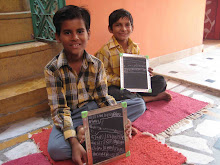
With this picture, for example, my plan was to get the kids to spell out 'THE MERASI SCHOOL' on the slates. But, as we primed and preened for the shot, what emerged was the discovery that Mr. Ali, the strapping lad in the center and a new student as of that day, didn't know how to spell 'MERASI.' And so a lesson instruced by his fellow slate-holders ensued.

But that's just one, bite-sized example of immediate reality or needs trumping intentions. Poverty, as we've talked about before, is a fickle master who will take your intentions and crush them like a two-ton stone crushes a china vase. Our intentions are well-founded and I used to think that reality gets in the way of my placing the turtle on the fence.

But what I'm slowing starting to believe is that I need to create more room for reality in the crafting of our intentions. Reality and all the baggage, packages and beautiful complications that come with, are powerful indicators of why the path from turtle in pond to turtle on fence is much more windy, precarious and beautiful than we originally bargained for.

Tuesday, December 30, 2008

The Percentages

Greetings from snowy Maine! Once again, I have timed it perfectly. I arrived home from The Merasi School at the IDEAL MOMENT for snow shoveling, sidewalk sanding and ice removal. Some of us, my dear friends, just have it made. But, in between hauling sky-high mounds of snow from this side of the driveway to the other, I'd like to offer a few post-trip reflections. And a particular favorite is one about percentages.

Co-founder Sarwar Khan and I often found ourselves chatting about what the necessary ingredients are for educational success in the Merasi community, what pieces of ideology and slices of belief need to go into our little cooker for a triumphant Merasi to emerge. While we certainly never landed on a definitive, Julia Child-eat-your-heart-out recipe, in part because our definition of success is fluid and ever-evolving, we inched just a bit closer to a formula I think is worth sharing.

Education, we came to agree, is 50% intellect, which our school is just brimming with, and 50% believing, which is a bit harder to unearth in many students. Most kids walk in the front door with more than enough ability to succeed in our classrooms, or really any classroom, for that matter. But it's the belief, the confidence that they can and will own this knowledge that's a bit tougher to find or cultivate.


Some of our students, like the Good (aspiring) Doctor Suriya Khan come into our lessons and classes with an innate confidence and we work to constructively build and grow that. Others, though, have a little less internal umph and one of our greatest academic challenges is to nourish and feed a sense of 'I can-itness' within our 41(!) students.

It's a tricky road to walk and one that we're just getting our footing on, but we're confident that our students' confidence and self-belief is within spitting distance. Now comes figuring out where, what and how great the distance is.

From all of us here at The Merasi School, have a merry, joyful and, of course, highly educational New Year!

Monday, December 15, 2008

A little something we like to say

There's a little something we like to say here at The Merasi School that goes to the tune of: Let unconquerable gladness dwell. It's a sentiment we stole right from FDR's Oval Office and transplanted into our desert classroom and the words echo through our hallways.

Now, if we are going to be total realists, my dear readers, what I just wrote was a boldfaced lie. For youngsters just wrapping their mouthes around 'red' and 'ball,' a multi-syllabic whopper like 'unconquerable' and the awkward consonants in 'dwell' are mish-mashed and pancaked smashed into all kinds of colorful variants. However, while the verbal packaging might be different, the contents are identical. Indefatigable joy resides at The Merasi School.

And there's nothing soft or gentle about this joy. It's a fierce current of energy that grows stronger and brighter with each student who joins our ranks and pours their young hearts and souls into developing core educational competencies to engage in a rapidly interdependent world. It's a joy that defies reason, because all reason says that these little ones --who are forced to drink from different water spouts than other castes and sit with the shoes in public places-- should lead joyless lives.

But if The Merasi School is anything, it is a small cluster of classrooms where possibility trumps reason and unconquerable gladness overpowers crippling reality. So as we charge through abc's and 123's with mighty merriment, we inch ever closer to the day when 'unconquerable gladness,' which is felt in so fiercely in the fibers of our little ones, can be just as fiercely verbalized.

Thursday, December 11, 2008

Observing with the Ears

I have a wonderful friend who loves to go to the symphony. We went together once and he sat like Rodin's The Thinker the whole time, while I shifted from one side of the seat to the other, reached for popcorn that wasn't there and clapped at all the wrong times. A few days later over breakfast, I asked him what he was doing and he said, "It's the best way for me to really see the music."

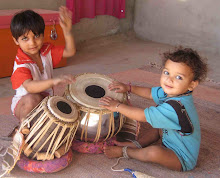
Fast-forward three years and three million cultural miles and I'm at The Merasi School with Sarwar Khan. We were talking about the Merasi musical legacy, a precious stand of songs that could easily wash away with the desert sands as modernization charges across India. "The thing is," Sarwar said, sweeping his hands towards the classrooms. "The kids observe with their ears. If there's no music being played, there's nothing to observe."

And it makes sense. The Merasi say they cry, sleep and laugh in rhythm, little boys and girls are as comfortable with a drum as they are with holding their mothers' hands. Music seeps through wind and time with a powerful cultural osmosis that is vanishing rapidly. "So it seems like part of what we're tying to do here," I said, "is put a somewhat more formal shape and a form into a style of learning that had a much more informal means of transmission." "Sure," Sarwar said. "We're giving them classes." Which was, of course, an infinitely more concise way of saying what I'd been swinging at.

So at The Merasi School, we learn with all our senses in all different ways. We see the landscapes in sounds and hear the loudness in landscapes. Our learning styles are as different as our handwriting, as distinct as our thumbprint. Each child that walks in the door brings a toolbox of potential learning matches that can be ignited if we commit to not just learning the word or the book, but learning the world.

Thursday, December 4, 2008

When the peanut gallery came center stage

Warmest and dustiest greetings from our desert classroom! I just touched down at The Merasi School a few days back and, save for the brief moment of disbelieving silence when a mouse the size of Toledo tottered arrogantly through our math class, all has been outside voices and unrestrained music-making ever since. While there have been many glorious moments that brought me to my knees, I'd like to share one with you about a little fellow named Swaroop.

Swaroop is about nine years old. He moves through space quietly and gently, with big brown eyes that sweep across the room before entering and then continue to observe and process as he adjusts into the space. I sat down with Swaroop the other day to conduct a baseline evaluation and see where he was at in terms of comfort and ability. We sat side by side on the green rug, going over abc's and 123's. When we got to the end of the baseline, I ask the question I always ask, which is, 'What do you want to be?'

Swaroop stared at me intently for a moment. The initial look in his eyes was one of total confusion. He was a boy who spent his days on the sidelines, not welcomed into the playing field and certainly never asked to take center stage. I thought, for a moment, that he wouldn't answer, but steadily, as he is with most things, Swaroop's eyes began to assert themselves and he said firmly, 'A doctor.' As I wrote it down, he said it again, quietly to himself. 'A doctor. Doctor Swaroop.'

And it was one of those rare moments when you are struck by what an amazing privilege it is to witness internal transformation on an external compass, like those beautiful brown eyes. So, amdist the raucous classes and energized music lessons, my great hope is that moments like this are quietly exploding inside students, little shifts in perspective and possibility where a child begins to see themselves as welcomed into a great whole.

Sunday, November 23, 2008

All-weather gratitude

My father and I talk baseball a fair amount. While my father churns out the facts, I fancy myself more of a color commentator, likening the field to a finely manicured chia pet or drawing powerful comparisons between the shape of a hot dog and the curve of the pitcher's wily smile. One foggy afternoon, my father and I were at the ballpark, watching intently as the clouds closed in at the top of the third. "DON'T let it rain," I declared. "In my book, this is not a day for rain." To which my father, rascal that he is, decided that today, he'd be adding the color to the commentary. "Satchel Paige used to say that if you pray when it rains, you'd better pray when it's sunny, too."

Thanks to Mr Paige and a few afternoon clouds, I've taken to a bit of all-weather prayer, which has opened up into all-weather gratitude. But, in truth, I've got it easy. Because in my line of work, it's folks like you, our Team Merasi members (you big-hearted studmuffins, you) who extend a hand when forecasts are gorgeous and lousy, who make me a continually appreciative soul. We hatch plans and cook up ideas, but each one of you provides the support needed to translate thoughts in our minds to actions in our hands. I, Caitie Whelan, am headed back to our desert classroom in just a few days and look forward to reporting from The Merasi School where a little rain and wind never gets in the way of a great day at school.

From our doorstep to yours, we send our heartiest and merriest thanks!

Friday, November 21, 2008

The Question that Keeps Coming

If we were to create a visual representation of The Merasi School, it would look something like so many Jackson Pollock's piece collaged together. Not because we're in a perpetual state of chaos, but because the most constant pattern in our work is unpredictability and the Great Unknown. While many painters gave us predictable scenes of cheery fruit and stoic portraits, Pollock produced works of unsettling beauty. And that's the most common pattern at The Merasi School. While poverty creates time structures with no rhyme or reason, our fierce little students' determination and grit make beautiful perseverance the foundation of our work.

So, the question that pops up all the time, over dinner and at coffee, among new friends and old ones, is almost always: "Why do you bother? What's the point? The situation is so bleak, the need is so high. How effective (and this part is always said very gently) do you hope one school to really be?"

And they're right...in some ways. Oftentimes, it seems as though the size of our solutions is dwarfed by the size of the problems. But you can't just walk away from that. There's an excellent Fitzgerald quote that goes something to the tune of "One should be able to see that things are hopeless, yet be determined to make them otherwise." We can hold two opposing realities in our hands: the bitter caste system and the tremendous hope of education and while the world may suggest that one is more important than another, it is our prerogative as thinking, acting beings to constantly reshape the value of realities towards the realization of justice.

Now have we fully realized that at The Merasi School? Absolutely not. Far from it. We are a perpetual work in progress. But we know that at least part of our effectiveness is embedded in the fact that we'll get up everyday with these two opposing realities in front of us and commit to making more space for the unsettling beauty that lies before us.